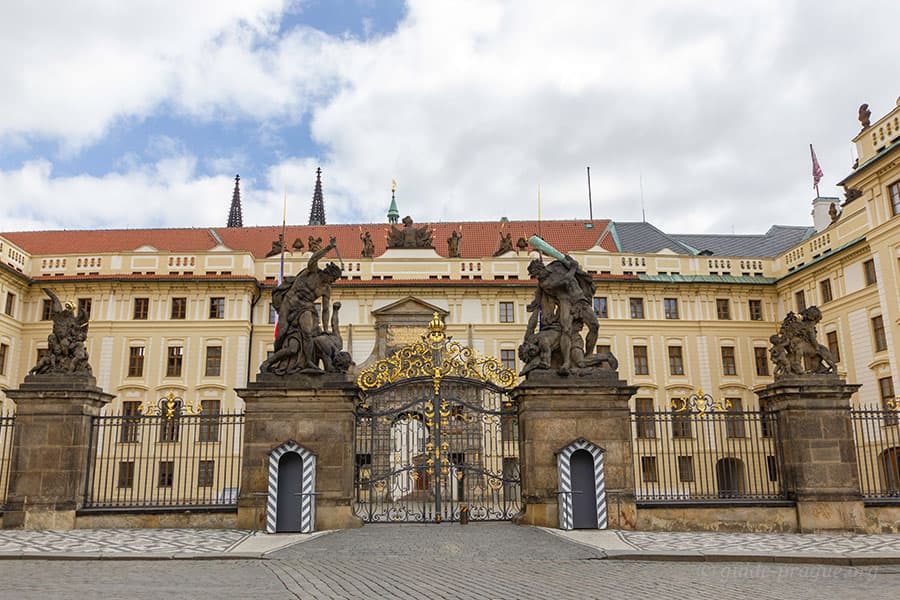
Prague Castle rises above the city on the left bank of the Vltava River. It is the largest castle complex in the Czech Republic, covering almost 70 000 m². Its buildings surround three courtyards. |
|
The First CourtyardNot so long ago, there was a deep moat on the site of the first courtyard. The only way to get inside was to cross the drawbridge. In the middle of the 18th century, Nicolo Pacassi filled up the moat and built the palace's southern and northern wings. This is how the First Courtyard of Prague Castle appeared. There are monograms of Empress Maria Theresa and Emperor Joseph II of Habsburg on the gates. The fighting giants and small cupids holding the symbols of the state — the Czech lion and the Austrian eagle — are the work of the 18th-century sculptor Ignaz Platzer. Matthias Gate leads from the first courtyard to the second. This gate was built at the beginning of the 17th century as the first Baroque building in Prague. |
|
|---|---|
The Second CourtyardThe early Baroque fountain from 1686 is named after its creator — the Kohl Fountain. On the top vase, we can see three Czech lions. An imperial eagle was standing on their heads once. But this symbol of the Habsburg empire was removed after the foundation of the independent Czechoslovak Republic. Right next to the fountain stands a well with an iron grate. |
|
 |
The chapel of the Holy Cross in the second courtyard was built in the 17th century. Two sculptures on its facade - St. Peter and St. Paul - are the work of Emanuel Max from the 19th century. A small porch with a bronze roof on thin columns next to the chapel serves as the entrance to the presidential office. |
| There were Renaissance stables on the first floor of the north wing (opposite the Chapel of the Holy Cross). Above them on the second floor was the famous gallery, where the emperor Rudolph II spent most of the day among his collections. He collected almost everything imaginable: works of art, sculptures, technical innovations, and natural wonders. There were more than three thousand priceless paintings, rare books, the world's first clock that showed seconds in his gallery. And between them, we would find such "values" as a unicorn's horn, a skeleton of a real dragon, a genie in a bottle, a mermaid's fin ... Most of the exhibits were taken to Sweden in 1648 at the end of the Thirty Years' War. The premises are used for exhibitions today. | |
The Third CourtyardThe Third Courtyard appears today as it did after the last major reconstruction in the 1920s. A granite monolith is a monument to the victims of the First World War, erected in 1928 on the occasion of the tenth anniversary of the Czechoslovak Republic. It is 15.5 meters high and weighs 112 tons. |
|
Next to it stands a sculpture of St. George that is more than 600 years old. It dates back to 1373. Do not miss the remains of the foundations of St. Vitus Basilica - the predecessor of the Cathedral. |
|
|
The Fourth CourtyardIf you decide to enter Prague Castle from Hradcanska Square, you will find yourself in the small park, which is sometimes referred to as the fourth courtyard. (You will need to go through the metal detectors near the Archbishop's Palace first.) This park is called Na Baste ("on the bastion"). In the arch leading to the second courtyard, we can see the preserved foundation of the Chapel of the Virgin Mary, built in the 9th century. |
Tickets and Working HoursPrague Castle is open to visitors from 6 am to 10 pm. The entrance to the courtyards is free. However, if you want to visit the Cathedral, Old royal palace, Basilica of St. George, or Golden Lane street, you will have to buy a ticket. Information on ticket prices and opening hours can be found at the Prague Castle website. |
|
|
If you want to make the most of your visit to Prague, there are plenty of exciting activities and tours to explore the city’s history, architecture, and culture. From guided walking tours through the Old Town to boat trips along the Vltava River, you can discover hidden gems and iconic landmarks. Check out a curated selection of top Prague experiences on the GetYourGuide platform to plan an unforgettable trip. |
|