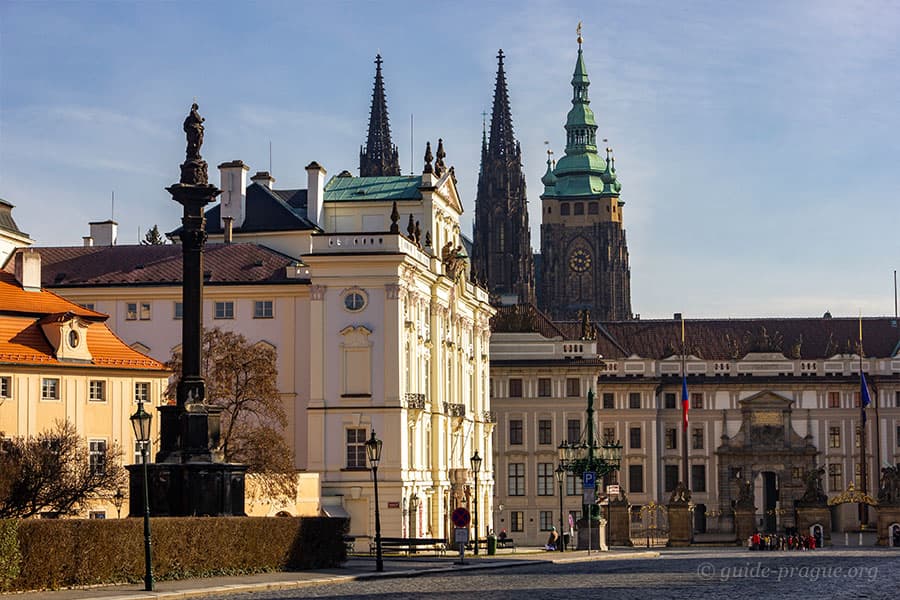
A long time ago, this square was surrounded by small houses belonging to residents of Hradčany. It might have remained this way if a devastating fire had not occurred in 1541. Most of the houses then burned down. Wealthy aristocrats began purchasing the cleared land and built magnificent palaces in Hradčany. Everyone wanted to have a residence close to Prague Castle. |
|
Opposite Prague Castle stands the Tuscan Palace. Count Michael Osvald Thun commissioned the palace in 1690. And in 1718 it was sold to Anna Maria Francesca Medici, the wife of the last Tuscany duke. This is where the name of the building comes from. Baroque sculptures behind the balustrade are the work of Jan Brockoff and the sculpture of St. Michael at the corner of the building was created by Ottavio Mosto. |
|
|---|---|
Today, the Tuscan Palace houses the Ministry of Foreign Affairs of the Czech Republic. |
|
|
Martinic Palace — one of the most beautiful Renaissance palaces in Prague — is located at the end of Kanovnická Street, to the right of the Tuscan Palace. At first glance, it seems that the building is small. But just imagine that at the beginning of the 19th century, the walls of the Martinic Palace were hiding 4 stairs, 2 stables for 32 horses, five courtyards, 2 fountains, 1 well, and numerous rooms. It was the second largest residence in Hradčany after the Czernin Palace. |
At the end of the 18th century, the palace was divided into apartments. After a large restoration in the 70s of the 20th century, the palace is used for concerts, conferences, and weddings. |
|
To the left of the Tuscan Palace stand the Church of St. Benedict (17th century) and the Discalced Carmelite Monastery. Do not miss the preserved sections of the 14th-century Hradčany fortification walls. |
|
Near the church is the Renaissance Schwarzenberg Palace. The whole building, including gables, and chimneys, is covered by sgraffitos. The palace was built by Italian craftsmen in the second half of the 16th century by the order of Jan Popel from Lobkowicz. Therefore, it is sometimes called Lobkowicz Palace. | |
|
It belonged to the Schwarzenberg family since 1719. But as the royal court was located in Vienna at that time, Czech aristocrats tended to move there also in order to be closer to the rulers. Prague palaces were often empty. The Schwarzenberg family provided their palace for free to the Technical Museum in 1908. During the Prague uprising of 1945, the palace was badly damaged and underwent a lengthy reconstruction. After that, the Military Museum used the building for a few decades. Today, Schwarzenberg Palace belongs to the National Gallery. |
To the left of the Schwarzenberg Palace, we see the Salmov Palace, built in the early 19th century in the style of Classicism. This building is also an exhibition venue of the National Gallery. On the corner of the palace, there is a monument to the first president of Czechoslovakia, Tomáš Garrigue Masaryk. |
|
To the left of Prague Castle is the Archbishop's Palace. The richly decorated rococo facade is the work of the architect Jan Josef Virch (mid-18th century). The sculptures decorating the palace were created by Joseph Platzer, one of the main baroque sculptors. From the 16th century to the present, this palace has been the seat of the Archbishop of Prague. |
|
The plague column on Hradčany Square was erected in the 18th century in memory of the epidemics that befell the city in 1713 and 1714, as well as a request to the saints that Emperor Charles VI had a son - heir to the throne (this request was not heard, Maria Theresa became the heiress). |
|
|
The sculptures were created by Ferdinand Maximilian Brockoff. At the top of the column is the Virgin Mary with a height of 206 cm. Below are the Czech patrons: St. Vitus, St. Wenceslas and St. Vojtech. A little lower are St. Charles Borromeo, St. John of Nepomuk, St. Elizabeth of Hungary, St. Peter Florian and St. Paul. There should have been St. Norbert as well, but the abbot of the Premonstrian monastery did not give money for the plague pillar. |
|
If you want to make the most of your visit to Prague, there are plenty of exciting activities and tours to explore the city’s history, architecture, and culture. From guided walking tours through the Old Town to boat trips along the Vltava River, you can discover hidden gems and iconic landmarks. Check out a curated selection of top Prague experiences on the GetYourGuide platform to plan an unforgettable trip. |
|