|
If we had come to Prague a thousand years ago, we would have found a vast market in the area where Old Town Square is today. It was located directly on the route from Prague Castle to Vyšehrad. People began to build the first houses along the roads connecting these two fortresses. By the 13th century, the settlement already resembled a real city. The market expanded, and the surrounding areas were built up in a more or less chaotic way. |
|
|
|
This is why it is quite easy to get lost in this part of Prague. Almost all the streets are crooked. Some parts of the market acquired a particular specialization, which can still be seen in the names of certain streets and squares: Rybná (Fish Street), Masná (Meat Street), and Uhelný trh (Coal Market). |
|---|---|
|
At the same time, city walls were built around the settlement. They served not only for protection but were also a privilege, as construction required the king’s approval. The walls of the Old Town stretched from the Vltava River near the Convent of Saint Agnes, approximately along the line of today’s Revoluční, Na Příkopě, 28. října, and Národní streets, and ended again at the bank of the Vltava River. |
|
|
There were seven main gates and five additional ones. Today, the only visible remnant of the fortifications is the Powder Gate and the names of certain streets, such as Na Příkopě (“On the Moat”) and Můstek (“Little Bridge”). A moat ten meters wide and eight meters deep surrounded the town. When the river level rose, the moat flooded, turning the Old Town into an island. |
|
|
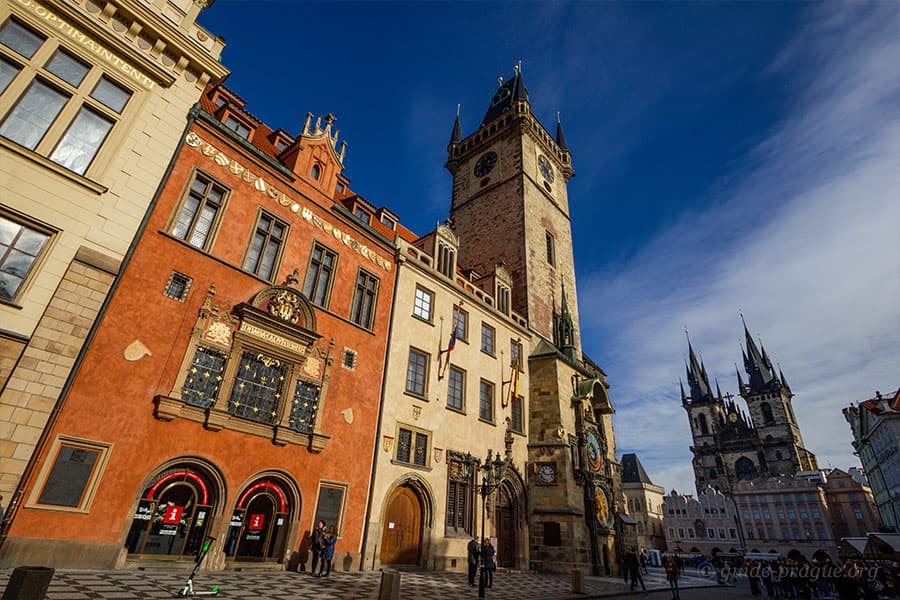
In the 14th century, the city received another privilege. King John the Blind of Luxembourg permitted the construction of the Town Hall. This very building, together with its famous astronomical clock, can still be seen today. |
|
|
|
The reforms of Joseph II of the Habsburg dynasty brought significant changes to the Old Town in the second half of the 18th century. At that time, many convents and churches were closed, including the Church of Saint Nicholas on Old Town Square. |
|
Even greater changes occurred at the end of the 19th and the beginning of the 20th century. Around 600 buildings were demolished during a large-scale redevelopment of the city. This project significantly affected the Jewish Quarter and the eastern part of the town, from Old Town Square to Republic Square. New buildings, mainly in the Art Nouveau style, were erected on the sites of the demolished houses. |
|
|
If you’re planning your visit and want a hassle-free way to explore the highlights of Prague’s Old Town, consider booking a guided tour or skip-the-line tickets for the Astronomical Clock and other attractions at GetYourGuide. |
|