|
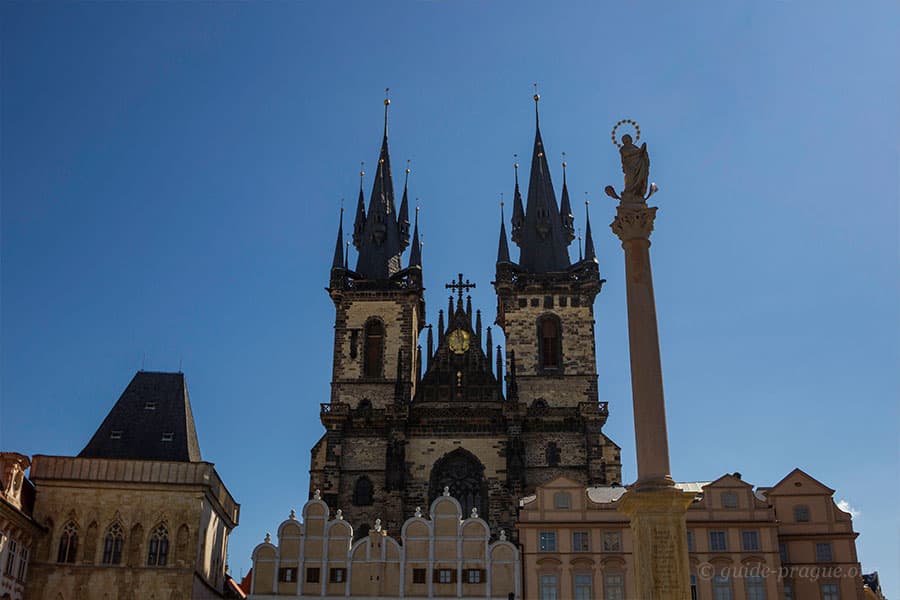
The construction of the Church of Our Lady before Tyn began in 1350 and was completed in 1511. Today, it is one of the most impressive Gothic buildings in Prague, and its eighty-meter-high spires are considered by many to be the most beautiful in the city. |
|
|
The church suffered severe damage in the fire of 1679 and was subsequently rebuilt. The Baroque style influenced mainly the interiors, while the exterior remains a classic Gothic basilica, modestly decorated at first glance. However, a visit to the narrow Tynska Street reveals the magnificent northern portal. The tympanum depicting the Crucifixion was most likely created by Petr Parler, the architect who also designed the cathedral at Prague Castle. |
|
|---|---|
|
In the 15th century, the Church of Our Lady before Tyn served as a stronghold for Prague's Hussites. The only elected Hussite archbishop, Jan Rokycana, served here. At that time, a statue of Hussite King George of Podebrady was placed on the gable between the two towers, with a large gilded chalice — a symbol of the Hussite movement — above it. In 1626, during recatholicization, the statue and chalice were replaced with a sculpture of the Madonna and Child; the chalice was melted down, and a halo was added to the Madonna. |
|
|
|
If you decide to explore the church's interiors, you may wonder where the entrance is — it is not easy to find! The entrance is through the Tyn School building, which stands directly in front of the church and was constructed around the same time. Inside, you can admire paintings by Karl Skreta and Jan Jiří Heinsch, as well as sculptures by Jan Jiří Bendl and Ferdinand Maximilian Brokoff on nineteen Baroque altars. Be sure not to miss Prague’s oldest baptistery, dating back to 1414, and the stone baldachin from 1493. |
|
It is believed that Archbishop Jan Rokycana, the heart of King George of Podebrady, and the heads of the decapitated leaders of the Bohemian Revolt may be buried in the Tyn Church, although none of these claims has been verified. However, the tombstone of the Danish astronomer Tycho Brahe, who worked in Prague, is authentic. |
|