|
Originally, a busy market stood on the site of today’s Old Town Square. Over time, a settlement grew around it without any formal plan, eventually developing into the Old Town. |
|
|
Old Town Square has always been the center of Prague’s public life. The Town Hall stood here, general assemblies were held here, royal decrees were announced, and public executions took place. The most famous execution on the square occurred in 1621. The hangman Jan Mydlar beheaded 27 leaders of the uprising against the Habsburgs. White crosses in the cobblestones near the Town Hall mark the place of execution. |
|
|---|---|
|
The houses surrounding the square date back to the Romanesque and Gothic periods. The facades that we see today were created mainly during the Renaissance and Baroque period. |
|
|
|
The House at the Stone Bell is one of the most valuable buildings on Old Town Square. It’s easy to recognize it: a stone bell hangs on the corner. For a long time, this beautiful Gothic house was hidden behind a Baroque facade. From 1975 to 1987, painstaking work was carried out, and the house got back its original medieval appearance. Since 1988, the building has been used by the Prague City Gallery for exhibitions. |
|
To the left of it is the Goltz-Kinsky Palace. Anselmo Lurago designed this Rococo palace for Count Jan Arnost Goltz. According to legend, the count bribed officials at the Old Town Hall to allow him to build a palace that would not follow the alignment of the surrounding houses. Soon after the construction was completed, Jan Arnost Goltz passed away. František Oldřich Kinsky bought the building. And the Kinsky family owned it until 1945. Today the palace is used by the National Gallery. |
|
|
In the center of the square stands a monument to Jan Hus - a priest and rector of Prague University. It is also believed that he proposed superscripts, which are still used in Czech spelling today. Hus lived in the late 14th and early 15th centuries. In his sermons in the Betlem Chapel, he began to criticize the Catholic Church because the clergy and monks cared more about power and wealth than about spiritual life. The Catholic Church declared him a heretic, and on July 6, 1415, Jan Hus was burned at the stake. The sculptor Ladislav Saloun created a monument to Jan Hus in 1915. |
|
|
We can also see the column with the Virgin Mary in the square. It is a copy of the column, which stood here from 1650 to 1918. There was a lot of controversy surrounding its restoration. Opponents saw it as a symbol of the 300 years when the Czech kingdom was part of the Habsburg monarchy. Supporters argued that the artistic and historical value of the column is more important. |
|
|
|
One way or another, a copy was installed in June 2020. And now, as in the old days, we can check the exact time by its shadow: precisely at noon, the shadow of the column falls on the Prague meridian marked in the cobblestones. |
|
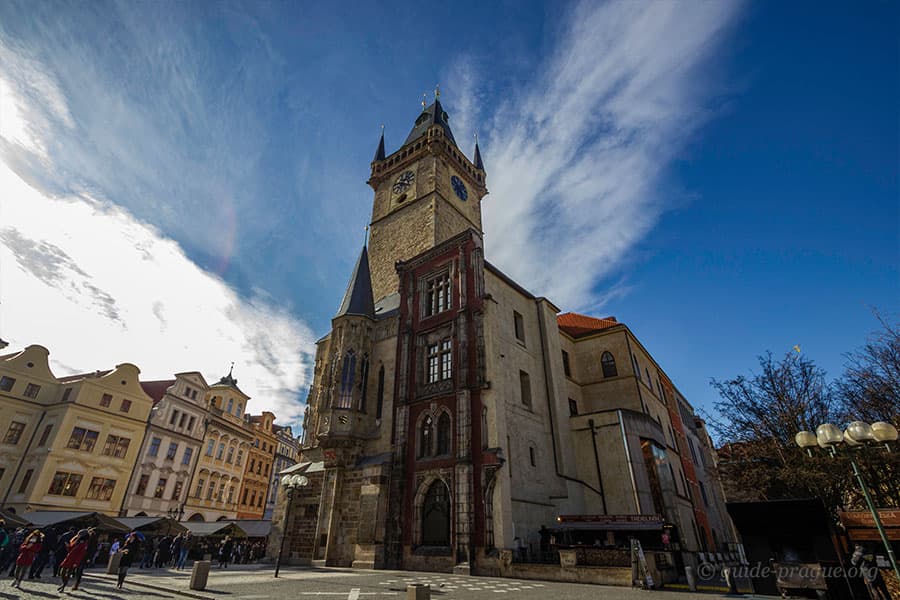
In the square, you can see two churches - St. Nicholas church and Church of Our Lady before Tyn — as well as the Old Town Hall with the famous astronomical clock. |
|
|
If you want to make the most of your visit to Prague, there are plenty of exciting activities and tours to explore the city’s history, architecture, and culture. From guided walking tours through the Old Town to boat trips along the Vltava River, you can discover hidden gems and iconic landmarks. Check out a curated selection of top Prague experiences on the GetYourGuide platform to plan an unforgettable trip. |
|