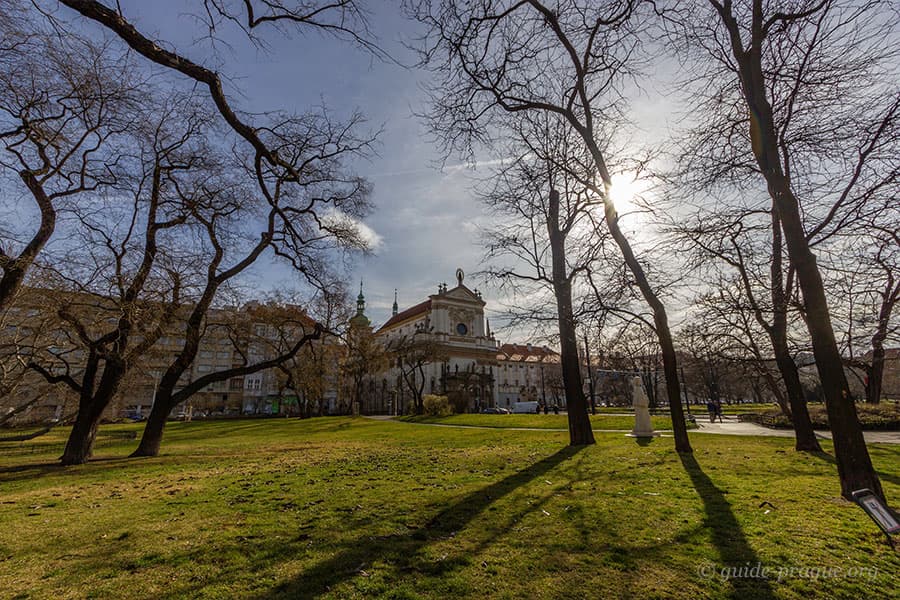
When Charles IV founded the New City of Prague, he intended the square—then known as the Cattle Market—to become the center of the new settlement. Today it is known as Charles Square. The king ordered a tower to be built in its center, where the coronation jewels, saints’ relics, and treasures from Karlštejn Castle were exhibited each year. This tower does not exist anymore. However, the New Town Hall still stands. The king’s plan was never fully realized. Wenceslas Square eventually became the city’s main center. Nevertheless, Charles Square is still the largest one. Its length is about 500 meters, and its width is about 150 meters. Remarkably, the square has retained its original size since the 14th century. |
|
|
The first mention of the New Town Hall dates back to 1377. So this building is not much younger than the more famous Old Town Hall. Additionally, two features rare in Prague can still be seen here. Firstly, on the eastern wing of the New Town Hall, do not miss a part of the chain. In the old days, such chains were used for closing streets at night. Secondly, here, as on the Hradcany Town Hall, the standard of measure of length - the Prague elbow ("loket" in Czech) - has been preserved. However, it cannot be examined up close. The city authorities placed it two meters above ground to prevent vandalism. And only at the market time, wooden steps were placed on the wall of the Town Hall, and anyone could check if the sellers of textile were honest. |
|---|---|
After the unification of Prague cities, there was a court and a prison in the New Town Hall building. Today it hosts exhibitions, concerts, and weddings. In the summer months, you can climb up to the 65-meter-high tower and enjoy views of the square and the New Town. |
|
Another notable building on the square is the Faust House. Of course, no Faust has ever lived here, but people have been using this name for centuries, and they always tried to bypass the house. It is not surprising. In the 14th century, Duke of Opava lived here. His main hobby was the natural sciences, and he set up various experiments at home. During the time of Rudolph II, the building belonged to the English alchemist (and most likely, the spy) Edward Kelly. Later on, Mladota of Solopysk, who was again an avid chemist, lived in the house. Around the same time, architect M. F. Kanka gave the building its Baroque façade. |
|
The house was empty for a while. The townspeople showed visitors a hole in the ceiling and said that it was through this very hole that the devil took Dr. Faust. In the 19th century, there was a school for the deaf in the building. And from 1903 to the present day, it has been used as a pharmacy. |
|
|
On the corner of Ječná Street and Charles Square stands the Church of St. Ignatius and the former Jesuit residence. This complex was built in the 17th century by the architect Carlo Lurago. Today the building serves as a hospital. |
The Neo-Renaissance building on the corner of Resslova Street and Charles Square is part of the Czech Technical University. It was built in the 19th century by the architect Ignaz Ulman. The sculptures of Labor and Science by Antonin Pop decorate the facade. |
|
|
If you want to make the most of your visit to Prague, there are plenty of exciting activities and tours to explore the city’s history, architecture, and culture. From guided walking tours through the Old Town to boat trips along the Vltava River, you can discover hidden gems and iconic landmarks. Check out a curated selection of top Prague experiences on the GetYourGuide platform to plan an unforgettable trip. |
|