|
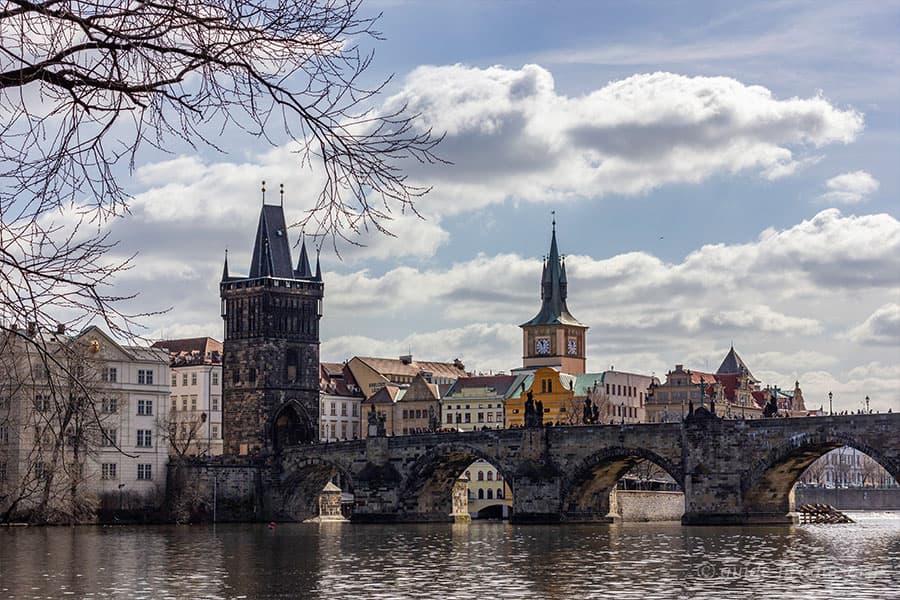
The predecessor of Charles Bridge — Judith's Bridge from the 12th century — was destroyed by a flood in 1342. King Charles IV invited Petr Parler — the same architect who built the cathedral at Prague Castle — to manage the construction of a new bridge. He also ordered an astrologer to determine the most favorable moment for construction to begin. |
|
|
|
That is why we know the exact minute when the foundation stone was laid. It happened on July 9, 1357, at 5:31 am. If we write these numbers as “1357 9 7 5 31”, we can read them both from left to right and from right to left. People believed that such a magic formula would help the bridge to stand forever. |
|---|---|
|
Construction of this bridge, 516 meters long and 9 meters wide, was completed at the beginning of the 15th century. |
|
|
The bridge has three towers — two on the Lesser Town side and one on the Old Town side. The lower of the Lesser Town Towers (Romanesque, with a Renaissance façade) is part of the old Judith's Bridge. The higher one is from the 15th century. |
|
|
The Old Town Bridge Tower was built by Petr Parler in the 14th century. We can still see beautiful Gothic decorations on the facade, facing the Crusaders' Square. When passing through the tower, do not forget to look up. Paintings from the end of the 14th century are preserved here, and the keystone has the shape of a St. Wenceslas crown. The decorations on the facade facing the bridge were destroyed during the Swedish attack on Prague in 1648. The Swedes then managed to conquer the left bank of the Vltava river, but their attempt to cross the bridge was unsuccessful. |
|
|
|
In the middle of Crusaders' Square stands the sculpture of Charles IV, the King of Bohemia and Holy Roman Emperor. This monument was erected to commemorate the 500th anniversary of the founding of the university in Prague. The female sculptures around it are symbolic figures of four parts of the medieval university: Faculty of Arts, Medicine, Law, and Theology. |
|
There are 30 sculptures of saints on the bridge. Most of them appeared here in the 18th century during the Baroque period. |
|
|
St.John of Nepomuk, sculpted by Jan Brokoff in 1683, is the oldest one. You can easily recognize him by the five stars around his head, and by the crowd of tourists. Legend says that Jan of Nepomuk was the confessor of Queen Sophia, the wife of King Wenceslas IV. He refused to reveal her secrets to the king, was tortured to death, and thrown from the bridge. People believe that if you touch the figure of St. John of Nepomuk on the relief and make a wish, it will undoubtedly come true. |
|
|
There is also a cross on the balustrade approximately in the middle of the bridge. It marks the place where the saint was thrown into the river. Place your hand on the cross and make another wish. |
|
|
If you want to make the most of your visit to Prague, there are plenty of exciting activities and tours to explore the city’s history, architecture, and culture. From guided walking tours through the Old Town to boat trips along the Vltava River, you can discover hidden gems and iconic landmarks. Check out a curated selection of top Prague experiences on the GetYourGuide platform to plan an unforgettable trip. |
|