|
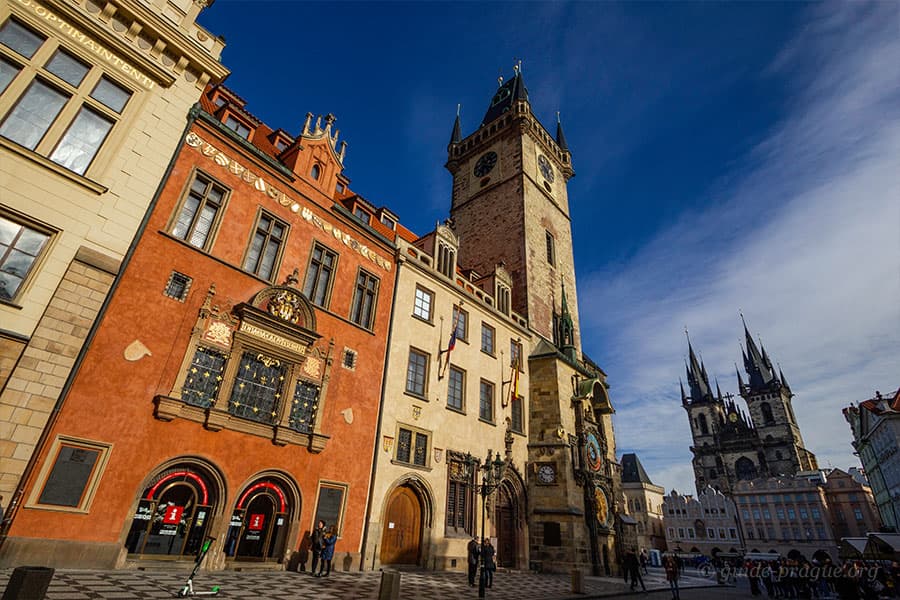
In 1338, King John of Bohemia granted the Old Town permission to build a town hall. The House of Wolflin of Kamen, dating back to the late 13th century, became the core of the new complex. It is the building located closest to the clock tower. Take a moment to admire its beautifully decorated Gothic portal. Soon after, construction of the clock tower began. As the city grew, the town council needed more space, so neighboring houses were purchased and new buildings were added. |
|
|
|
The southern wing—the last addition to the Town Hall complex—was built in the 19th century. It was destroyed during the Prague Uprising at the end of World War II and has never been rebuilt. Today, a small park occupies its former site. The construction of the 69.5-meter-high clock tower was completed in 1364. Do not miss the richly decorated bay window of the chapel on the first floor of the tower. It is considered one of Prague’s most beautiful 14th-century monuments. |
|---|---|
|
Another attraction of the tower is the astronomical clock, also known as the Orloj. The word “orloj” comes from an old German term referring to a sophisticated clock mounted on a tower. These clocks displayed not only the time but also the position of celestial bodies above the place where they were installed. Only two astronomical clocks have been preserved in the Czech Republic: one at the Old Town Hall in Prague and the other at the town hall in Olomouc. |
|
|
The Prague Astronomical Clock was created in 1410. Jan Šindel, a professor at the University of Prague, and Mikuláš of Kadaň worked on its construction. During the Hussite Wars, the clock was severely damaged and later repaired by Master Hanuš of Růže. |
|
|
Throughout its centuries-long history, the astronomical clock has stopped several times and required repairs. However, the fact that more than two-thirds of its components have been operating without replacement for over 600 years is truly impressive. |
|
|
|
The point where all the clock’s hands meet represents Prague’s position on the globe. The yellow ball on the yellow hand represents the Sun (in the 15th century, people believed that the Sun revolved around the Earth). The black ball on the black hand represents the Moon. The dial also features a circle with symbolic images of the zodiac signs. The gilded lines indicate astronomical time, the Tropic of Cancer, and the Tropic of Capricorn. The multicolored sections symbolize Day, Night, Dawn, and Dusk. |
|
At the lower part of the tower, visitors can also see a calendar dial. The original calendar, created by Master Janus, has not been preserved. What we see today is the work of the Czech artist Josef Mánes from the 19th century. |
|
|
At the center of the calendar dial is the coat of arms of the city of Prague—three towers and an open gate. Surrounding it are twelve medallions with zodiac signs and twelve scenes from rural life, symbolizing the months of the year. Along the outer edge runs a white ring with 365 lines, one for each day of the year. A small gilded arrow at the top indicates the current day and month. At midnight, the calendar disk moves forward by one division. |
|
|
The figures on the left and right sides of the dial have symbolic meanings. The figure holding a mirror represents Vanity. The man with a pouch symbolizes Greed. The Skeleton represents Death, while the Turk with a lute symbolizes earthly pleasures. Additional immovable wooden figures are placed at the level of the calendar: the Philosopher, Archangel Michael, the Astronomer, and the Chronicler. |
|
|
|
Every hour, a procession of the Apostles takes place on the tower. The Skeleton rings the bell, the blue windows open, and the twelve Apostles appear. Each can be identified by his attribute, such as Saint Peter with a key, Saint Matthew with an axe, Saint Thomas with a spear, and others. |
|
If you want to make the most of your visit to Prague, there are plenty of exciting activities and tours to explore the city’s history, architecture, and culture. From guided walking tours through the Old Town to boat trips along the Vltava River, you can discover hidden gems and iconic landmarks. Check out a curated selection of top Prague experiences on the GetYourGuide platform to plan an unforgettable trip. |
|