Vyšehrad is unique. We can hardly find another place in Prague with so many legends associated with it. |
|
|
According to early chronicles, the forefather Čech arrived at Mount Říp with his retinue and ruled the Czech lands for 30 years. After that, Krok became a ruler. A prophecy warned him that misfortune would befall his settlement. To avoid this, Krok moved his throne to a high rock above the Vltava river. He founded a new settlement called Vyšehrad. When Krok died, one of his daughters - Libuse - began to rule. From Vyšehrad she prophesied the future glory of Prague and called the legendary founder of the first dynasty of Czech kings - Přemysl - to Vyšehrad. |
|---|---|
Legend says that the duchess hid gold bars inside the Vyšehrad rock. They were said to be so large that no adult man could lift them. They also said that she drowned a golden cradle in which she rocked her children in the Vltava river. The prophecy said that it would come to surface when a great ruler appeared at Prague Castle. The prophecy was believed to have come true when the last queen of the Přemyslid dynasty gave birth to a son - the future King of Bohemia and Holy Roman Emperor Charles IV. Another legend said that everybody, who drowned near Vyšehrad, ended up in an army hidden under a rock. And that army was supposed to come to the rescue when the most difficult times come for the Czech lands. |
|
The reality, however, is less romantic. Vyšehrad was founded by Czech dukes to guard the trade route along the Vltava. It happened about the middle of the 10th century, definitely after the foundation of Prague Castle. In the second half of the 11th century, Duke Vratislav II (and the first Bohemian king Vratislav I) moved his residence from Prague Castle to Vyšehrad due to disputes with the church. Here he built a magnificent Romanesque palace. The chronicles say that more than 3,000 people could fit in it! The building has not survived to the present day. But the sculptures of Myslbek suggest its approximate size. They depict characters from Czech mythology: Premysl and Libuse, Lumir and Pisen, Ctirad and Sarka, Zaboj and Slavoj. The statues once decorated the Palacky Bridge but fell into the river during the bombing in 1945 and were brought to Vyšehrad after that. |
|
Vratislav II ordered the construction of the Basilica of St. Peter and Paul on Vyšehrad and founded a chapter, which did not obey the Prague bishop, but directly to the Pope. He also built the oldest surviving Romanesque monument in Prague - the St. Martin's Rotunda. After the death of Vratislav, the Czech dukes continued to live on Vyšehrad. They moved back to Prague Castle only in the middle of the 12th century. |
|
|
In the 14th century, Charles IV returned Vyšehrad to its former glory. He ordered to rebuild the Church of St. Peter and Paul and build a new Gothic palace. He also surrounded Vyšehrad with fortress walls. The remains of the Gothic gate called Spicka can still be seen today on one of the Vyšegrad houses. Vyšehrad became so important that even the coronation procession started here. |
During the Hussite wars, Vyšehrad was destroyed almost to the ground. Small artisans and merchants settled here. But in the second half of the 17th century, everyone was evicted. A military citadel was built on the site of the settlement. It is still reminiscent of mighty fortress walls and bastions, Leopold's and Taborska gates, casemates. With the development of firearms, the fortress's importance diminished, and in the 19th century, the army abandoned it. |
|
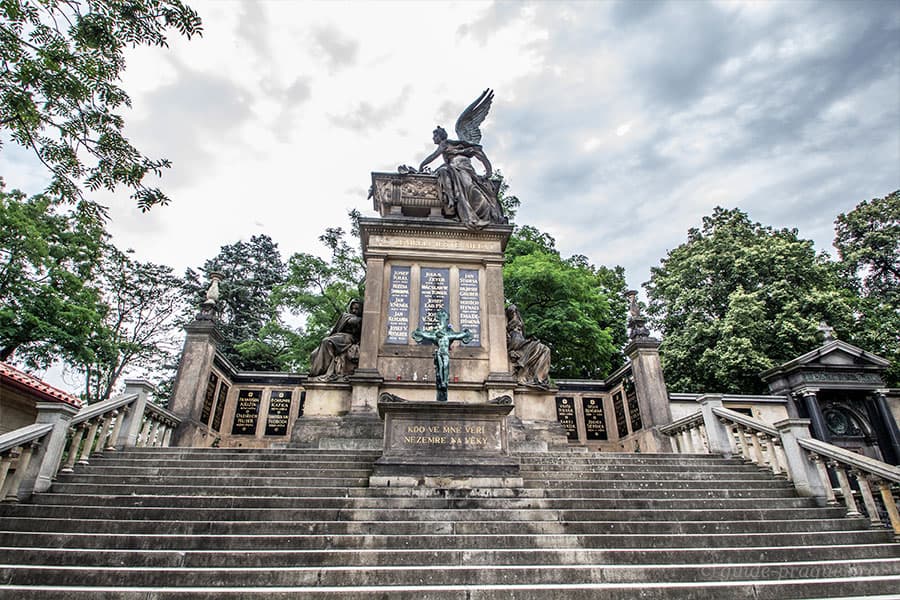
Vyšehrad has become a symbol of Czech national identity. At the end of the 19th century, the architect Josef Mocker began a Neo-Gothic reconstruction of the Church of St. Peter and Paul. At the same time, the small parish cemetery turned into a national one, where the most famous Czechs were buried. We can find gravestones of the writers Karel Hynek Macha, Jan Neruda, Bozena Nemcova, Karel Capek, composers Bedrich Smetana and Antonin Dvorak, artists Mikolas Ales and Adolf Kaspar here. The main monument at the cemetery is Slavin - the common grave of famous personalities. Here rest artist Alphonse Mucha, singer Emma Destinova, sculptors Josef Vaclav Myslbek and Ladislav Saloun. |
|
Today, Vyšehrad offers peaceful walks through landscaped parks. A magnificent view of Prague opens up from the fortress walls. |
|
|
If you want to make the most of your visit to Prague, there are plenty of exciting activities and tours to explore the city’s history, architecture, and culture. From guided walking tours through the Old Town to boat trips along the Vltava River, you can discover hidden gems and iconic landmarks. Check out a curated selection of top Prague experiences on the GetYourGuide platform to plan an unforgettable trip. |
|